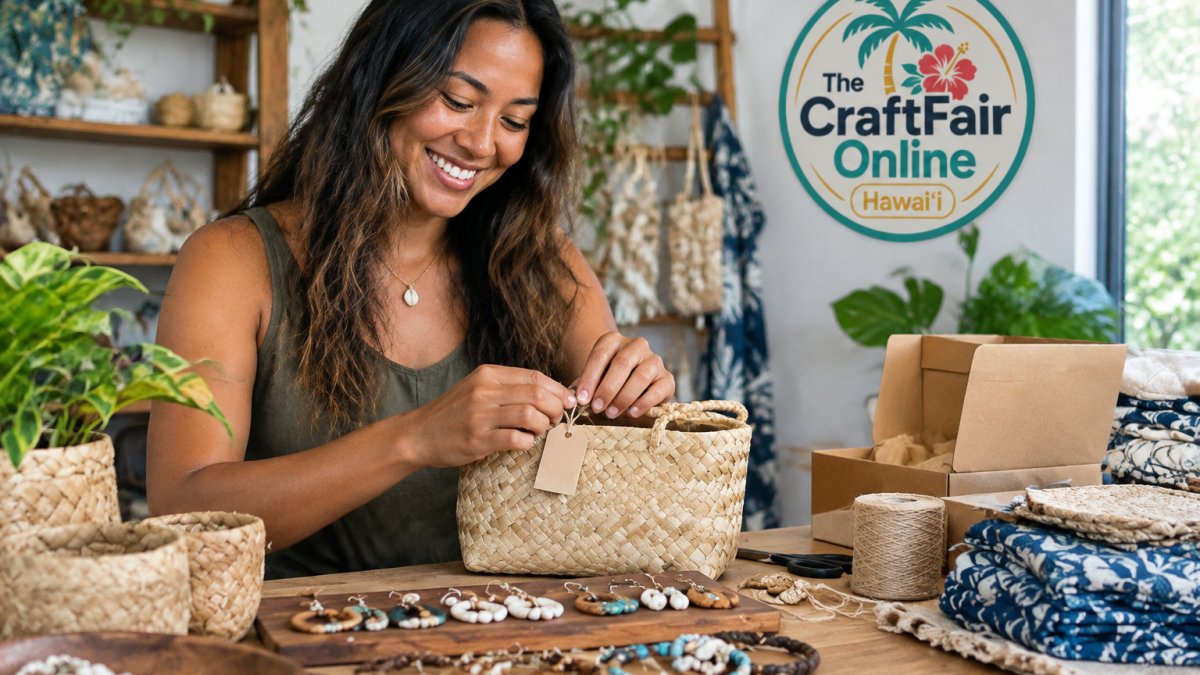
7 Steps to Sell Maui Handmade Crafts Online
Last Updated: November 21, 2026
Quick Summary
To sell handmade crafts online, first decide what each channel must do for you, since marketplaces, your own shop, social media, local fairs and digital booths each serve a different purpose. Then price for full costs, photograph well, and check Hawaiʻi tax and permit rules before you list.
- Compare each platform by fees, audience, and how much control you keep over customer contacts.
- Count materials, labor, overhead, fees, packaging, shipping, and marketing when setting every price.
- Capture customer contact information at fairs so past buyers can find your online shop again.
- Shoot product photos in natural light against a plain background, from several angles, plus one in use.
- Hawaiʻi uses a general excise tax on gross business income rather than a conventional sales tax.
Table of Contents
- Why Your Fair Customers Need an Online Home
- Places to Sell Handmade Items Online
- How to Price Handmade Crafts for Profit
- Handmade Product Photography Tips That Sell
- Selling Crafts Online Legally in Hawaiʻi
- Shipping Maui Crafts to Mainland and Overseas Buyers
- Your Next Step: Set Up Your Digital Booth
- Frequently Asked Questions
Why Your Fair Customers Need an Online Home
Many makers in Hawaiʻi build loyal followings at craft fairs. Shoppers meet you, touch your work, and leave with a piece they love. Then the fair ends, and that connection often fades. If you want to sell handmade crafts beyond the fair, your past customers need an easy way to find you again through an online home.
A digital booth gives those customers a place to return. It keeps your work visible between markets, so a shopper who met you in Kīhei can still see what you made last month. It also gives you a way to share new pieces, announce upcoming events, and reach buyers who could not attend in person.
The Craft Fair Online is designed to help makers do this. Our digital booths let you show your products, keep your story in one place, and stay connected with the people who already value your work. Start by thinking about one simple question: when a customer wants to buy from you again, where will they look?
Places to Sell Handmade Items Online
Makers have several options when they decide to sell handmade crafts online. Each one serves a different purpose, and the right mix depends on your products, your time, your margins, and how much control you want over the customer relationship. The mistake most new sellers make is picking a platform before they know what they need it to do.
A study on the popularity of handmade products among consumers examined how consumers view handmade goods, which helps explain why buyers seek out craft items online. Demand exists. The question is where your buyers already shop and how much of each sale you keep.
Comparing Platforms by Fees, Audience, and Control
Before you choose a platform, compare four things: who is already shopping there, what it costs to list and to sell, who owns the customer relationship, and how much shipping and fulfillment work lands on you.
- Large marketplaces: Built-in traffic and shopper trust, but listing fees, transaction fees, and payment processing stack up. Competition is intense, and you rarely own the customer's contact information. Good for discovery; weaker for building a repeat-buyer list.
- Your own website or shop: You control branding, pricing, and the customer list. You also carry the full burden of driving traffic, maintaining the site, and handling every support question. Best once you have an audience to send there.
- Social media: Free to start and strong for showing process and new work. Conversion is the weak point, because checkout happens off-platform and buyers get distracted. Treat it as the front door, not the cash register.
- Local and community channels: Craft fairs, pop-ups, galleries, and visitor-oriented retail reach buyers who already value handmade work. These channels feed your online shop when you capture contact information at the booth.
- A digital booth: A dedicated profile page that sits between a marketplace and your own site. You present your work and story in one place and link shoppers to what is available, without building a full storefront.
Check current fee schedules directly on each platform before you commit, since fees change and processing rates vary by payment method. A useful exercise: take one representative product, subtract every platform and processing fee, then subtract your materials, labor, and packaging. Whichever channel leaves a margin you can sustain is the one to lead with.
A Simple Decision Path
Ask yourself three questions in order. First, do buyers already search for your type of product on a marketplace? If yes, list there for discovery. Second, do you have a way to capture a customer's email or contact so you can bring them back? If not, fix that before you spend on ads. Third, can you fulfill orders reliably from your location, including packaging and postage? If shipping is a bottleneck, start with local and in-person channels while you build the online side.
Most makers end up with a mix: a marketplace or booth for discovery, social media for storytelling, and a contact list they own. The point is not to be everywhere. The point is to be findable where your buyers look and to keep a relationship you can return to.
Where a Digital Booth Fits
A digital booth sits between a marketplace and your own website. It gives you a dedicated space to present your work, share your story, and link shoppers to what is available, without the setup and maintenance of a full storefront. Many makers use a booth alongside social media, using posts to bring people in and the booth to hold their attention.
Our Craft Fair Online digital booths are one option for this. Think of it as your home base, the place your fair customers and new shoppers can always find you. A booth is a visibility tool, not a guarantee of sales; what you do with the attention is the real work.
The right channel depends on your fees, your audience, and how much of the customer relationship you want to keep.
| Channel | Best for | Key difference |
|---|---|---|
| Large marketplaces | Discovery and built-in traffic | Listing and transaction fees; you rarely own customer contacts |
| Your own website or shop | Control and branding | You carry all traffic and maintenance work |
| Social media | Showing process and new work | Free to start, but checkout happens off-platform |
| Local and community channels | Buyers who value handmade work | Capture contact info at the booth to feed your online shop |
| A digital booth | Presenting work and story in one place | Sits between a marketplace and your own website |
How to Price Handmade Crafts for Profit
Pricing is where many makers struggle. A price that feels fair to you may leave little money after costs are covered. Start with the full cost of making each item.
Count these costs for every piece:
- Materials: The actual cost of what goes into the item.
- Labor: The time you spend making it, valued at a rate you can sustain.
- Overhead: Tools, space, utilities, and equipment, spread across your output.
- Fees: Platform, payment processing, and booth costs.
- Packaging and shipping: Boxes, tissue, labels, and postage.
- Marketing: Photos, promotions, and event costs.
Once you know your full cost, decide what profit you need to keep the business going. Profit is what remains after every expense, and it is what funds your reserves and future growth. Revenue alone does not tell you whether a sale helped your business.
Watch out: A common mistake is pricing only materials and labor and forgetting fees and packaging. Those hidden costs can erase your margin on small items.
Handmade Product Photography Tips That Sell
Good photos help shoppers trust your work. Buyers cannot pick up a piece online, so your images must show it clearly.
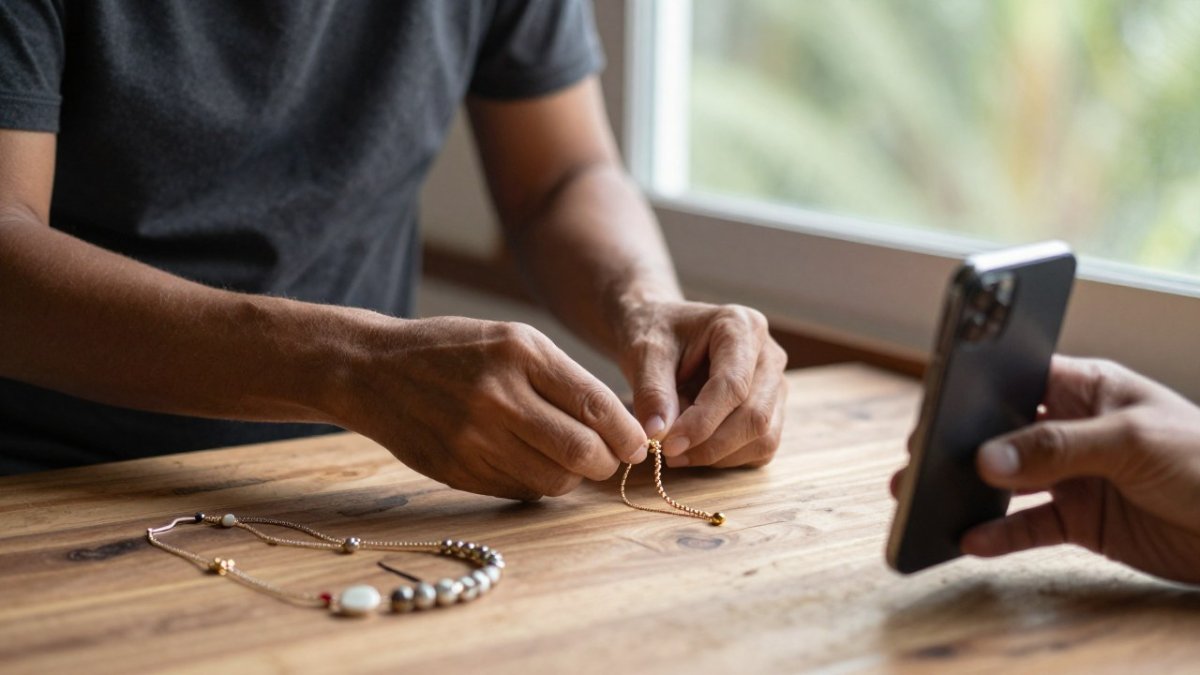
A Maui maker arranging handmade jewelry on a natural wood surface beside a window with soft island light, a phone propped up to photograph the piece.
Use these practical tips:
- Shoot in natural light near a window, avoiding harsh midday sun.
- Use a plain background so the product stands out.
- Show the item from several angles, plus one photo of it in use.
- Include a size reference, such as a hand or a common object.
- Keep your images consistent so your booth looks cohesive.
Clear photos and honest descriptions reduce returns and build confidence. Describe materials, dimensions, and care instructions in plain language.
Selling Crafts Online Legally in Hawaiʻi
Selling online comes with legal and tax responsibilities, and the rules depend on what you sell, where you sell it, and how much you earn. None of the general guides ranking for this topic address local obligations, so this section is where you get the island-specific picture. Treat it as a map of what to check, not as legal or tax advice.
Business Registration and Licensing
At the state level, sellers who operate as a business typically need to register with the appropriate Hawaiʻi state agency. Check requirements directly with the state, because requirements and filing steps change.
At the county level, rules vary. If you sell at markets, fairs, or from a physical location, ask the county about vendor permits, zoning, and any home-occupation rules that apply to where you make or store your products. Do not assume a state registration covers county requirements.
General Excise Tax
Hawaiʻi does not use a conventional sales tax. Instead, the state imposes a general excise tax (GET) on gross business income. Confirm current rates, applicable county surcharges, and filing frequency directly with the Hawaiʻi Department of Taxation, and build the tax into your price rather than discovering it after the fact.
If you sell through a marketplace, the platform may collect and remit tax on your behalf for some transactions. Do not assume it does for all of them. Read the platform's tax documentation and reconcile it against your own records.
Income Tax and Recordkeeping
Federal and state income tax apply to your net profit, which is revenue minus allowable business expenses. The IRS guidance for small business owners on reporting self-employment income explains self-employment tax and estimated payments. Keep records of sales, expenses, platform fees, postage, and any taxes collected. A simple system, such as a separate business bank account and a monthly reconciliation, saves hours at filing time and makes it easier to see whether you are actually profitable.
Permits and Product-Specific Rules
Some products carry extra requirements. Food and consumables, cosmetics and skin care, candles and other items with labeling rules, and products made from certain natural materials may fall under additional state or federal rules. If your work uses regulated or restricted materials, check before you list. When in doubt, ask the agency that oversees that product category.
Provenance and Honest Claims
Origin-based positioning can distinguish your work, but only if it is accurate. Describe where materials come from and where the item was made in plain language. Avoid implying an item is made in Hawaiʻi if it is assembled elsewhere, and avoid cultural claims you cannot support. Accurate provenance builds trust and protects you from disputes.
We recommend speaking with a qualified tax professional about your specific situation. Our guidance here is educational and does not replace individualized advice.
Shipping Maui Crafts to Mainland and Overseas Buyers
Shipping from Maui adds cost and planning. Postage to the mainland and overseas can be higher than what buyers expect, so build shipping into your pricing from the start.
Consider these points:
- Compare postage options from carriers, and check current rates before quoting.
- Use sturdy packaging for fragile pieces, and protect items from humidity.
- Explain shipping costs and timelines clearly on your listings.
- Decide whether to offer free shipping and absorb the cost, or charge it separately.
For international orders, check customs requirements and any duties the buyer may owe. Clear communication prevents surprises and keeps customers coming back.
Your Next Step: Set Up Your Digital Booth
You now have a clear path: understand where your fair customers can find you, price your work to cover every cost, present it with good photos, and ship it with care. The next step is to put your work in front of the people who want it.
Set up your Craft Fair Online digital booth and share the link with the customers you met at your last fair. Keep your story, your photos, and your current pieces in one place so every shopper can find you again.
Ready to keep your fair customers connected? Set up your digital booth at The Craft Fair Online and give your island creations a home that lasts beyond the market day.
Frequently Asked Questions
Where can I sell handmade crafts online?
Common options include dedicated craft marketplaces, your own website, social media shops, and curated digital booths. Marketplaces bring built-in shoppers but typically charge listing and transaction fees; check current fee schedules directly on each platform. Your own site keeps more control and fees low, but you must bring traffic yourself. Many Maui makers combine a digital booth with local fairs so past customers can find them again between events.
How do I price handmade crafts for online sales?
Start with materials, then add the time you spend making each piece at a rate you can sustain. Add a share of overhead such as tools, packaging, and rent for your workspace. Then include platform fees, payment processing, and shipping. Finally, add a profit margin so your price covers reserves and owner pay, not just costs. Revenue is not profit, so check your margin after every fee before you publish a price.
What should I know about selling crafts online legally in the United States?
Check your state registration and general excise tax obligations with the state before you start, since online sales can create tax duties. Keep records of every sale and any tax collected. Verify current rules directly with the state, because requirements change.
Can I sell handmade crafts online and at local fairs at the same time?
Yes. Many makers use physical fairs to meet people and an online booth to keep those relationships going. Track which products sell at each channel so you can adjust inventory and pricing. Use a simple sign at your fair booth that points customers to your online storefront, and keep your product listings consistent with what you show in person.